
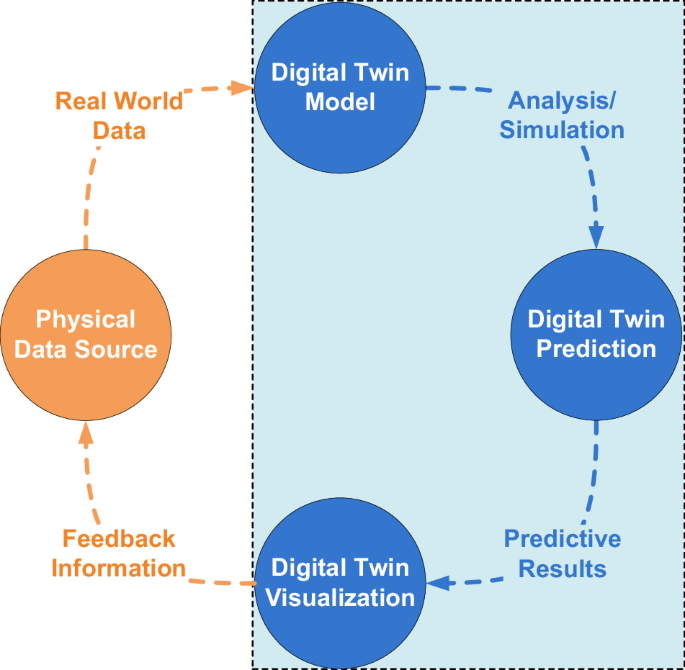
DT technology is still in its early stages within the healthcare domain. There is a significant journey ahead to develop fully functional personalized, resource management, and societal DTs tailored to human healthcare needs. Addressing this task involves dealing with a myriad of issues, challenges, and research directions that require further brainstorming and exploration. Outlined below are the key areas of healthcare-related DT that demand significant investigation:
Prognostic analytics and modeling
Forecasting the progression of medical conditions is crucial for effective disease management. However, effective prediction requires careful modeling of disease development patterns. It requires representative historical and ongoing health data, alongside behavioral, environmental, and biological factors, such as genomics, transcriptomics, proteomics, and metabolomics. Additionally, effective forecasting requires iterative tuning of model parameters to minimize the gap between model predictions and real-world observations.
Dynamic predictive models may anticipate health issues and disease development trends, thereby enabling informed decisions regarding prevention and cure methodologies in advance. Likewise, personalized physiological models can estimate future behaviors derived from collected data. However, implementing these models to replicate the intricate functionality and interactions of human organs in a DT environment presents a formidable challenge, requiring the refinement of AI-driven SDT models to enhance their adaptability to real-time epidemiological data. Addressing this challenge requires the development of robust mechanisms for constructing and refining dynamic predictive models. Achieving this goal entails thorough investigation and innovative solutions.
Personalized treatment
The seamless availability of DT can provide an interactive environment. It may enable users to get insights into their personalized health conditions and suggestions to improve their well-being. However, developing personalized DT for predicting medications based on a patient’s age, health condition, comorbidities, and the genetic makeup (mutations and biomarkers) is a complex task that requires further investigation. A future challenge is to utilize machine and deep learning approaches to understand personalized patient profiles based on biological signatures and clinical phenotypes. It may enable physicians to prescribe personalized treatment and precision healthcare to patients.
Personalized training
Medical treatments usually follow an established set of procedures and protocols to ensure safe treatment. A DT modeling and simulation environment can provide an ideal solution to implement complex medical procedures optimally. In doing so, it may provide an interactive, hands-on, and evidence-based training environment to medical professionals, where trainees may get 24/7 access to virtual medical resources, enhancing their competence and interdisciplinary knowledge. Moreover, DT may provide a flexible environment for skill evaluation by incorporating rigorous assessment, appraisal, and gauging procedures. A DT may serve as a resilient resource even in emergency conditions, allowing paramedic staff to receive fast-paced 24/7 training for dealing with critical situations or pandemics.
Despite the numerous advantages of DT technology in leveraging medical training, it may suffer from critical challenges as well. For example, modeling evidence-based training and adaptability mechanisms based on cutting-edge research and best practices in a DT environment is very challenging. Furthermore, complying with legal, ethical, and safety standards, along with cultural sensitivity issues, to leverage effective personalized training through DT is a future challenge. Therefore, there is still a long way to go to create personalized DT trainers that can provide professional-grade training comparable to that of experienced healthcare professionals for effectively handling crisis situations.
Interdisciplinary coordination
As a multidisciplinary field, SDT requires effective communication among stakeholders (e.g., patients, data scientists, bioinformatics specialists, and healthcare professionals) to ensure seamless development, integration, and innovation in the healthcare domain. Facilitating such collaboration promotes actionable insights and knowledge transfer among stakeholders, which is crucial for effective SDT implementation.
Furthermore, standardizing communication protocols can streamline structured data sharing and role-based access control, both of which are essential for fostering a collaborative environment that integrates diverse expertise from healthcare and technology. Therefore, modeling a versatile interdisciplinary SDT framework in the healthcare domain, where all stakeholders achieve a win-win scenario, remains a significant challenge.
Key actionable steps for interdisciplinary coordination among experts from data science, medicine, and engineering include:
-
1.
Shared Goals: Define actionable goals aligned with the priorities and objectives of relevant stakeholders.
-
2.
Standardized Communication Protocols: Develop protocols to mitigate communication gaps and foster a culture of diversity and collaboration.
-
3.
Advanced Healthcare Platforms: Leverage cutting-edge technologies such as AI, ML, AR, VR, ER, DT, and blockchain to create advanced healthcare metaverse platforms for seamless collaboration in the digital world.
-
4.
Training and Workshops: Organize interdisciplinary sessions to equip stakeholders with essential interdisciplinary knowledge and expertise.
-
5.
Feedback Mechanism: Establish regular channels to highlight and coordinate unfinished tasks, improving workflow efficiency and progress tracking.
-
6.
Appointing Facilitators: Consult interdisciplinary leaders to resolve communication gaps by streamlining shared workflows and fostering team cohesion.
-
7.
Key Performance Indicators (KPIs) Metrics: Utilize KPIs to evaluate interdisciplinary coordination and refine objectives and strategies accordingly.
User experience
For effective human-computer interaction, a DT may embody properties such as responsive web design, fast loading web apps, easy access and navigation, personalized dashboards, browser compatibility, and customer feedback mechanisms. Moreover, user experience can be improved by creating intuitive user interfaces and informative graphs. This may aid in an increased understanding of data. It may empower patients, technologists, and healthcare professionals to make more informed decisions about ongoing medical conditions. However, devising effective mechanisms for capturing and understanding user preferences and leveraging them to enhance user experience in the digital arena is a significant challenge.
Digital twin availability
Like many other new and demanding technologies, initial DT products are likely to be costly, considering general market trends. Due to financial disparities, life-changing and life-saving DT technology may only be accessible to wealthy patients, thereby promoting social inequality and unfairness32 and further exacerbating socio-economic disparities29,32. Henceforth, it is imperative for governments, non-profit organizations, and health insurance companies to invest in the R&D of DT technology. Doing so may help make DT technology available to the general population. Additionally, it may potentially mitigate the trend of healthcare technology usage being contingent on social status and economic well-being.
Digital twin scalability
DT ranks among the most demanding technologies of the information era, which is presumed to be readily adopted by future healthcare systems. Achieving this requires the development of expandable and adaptable approaches for creating more robust and flexible DT solutions in the future. A scalable DT may scale up horizontally or vertically, thereby aligning with the Digital Twin as a Service (DTaaS) paradigm. In the case of horizontal expansion, DTaaS may facilitate the emergence of new DT(s) within the DT ecosystem, whereas vertical expansion refers to maturing the existing DT(s) by adding new functionality under the DTaaS mechanism. In any case, scalability would increase the amount of data received, processed, and analyzed by the DT ecosystem.
However, ensuring efficiency while accommodating increasing user requirements is paramount for implementing scalable DT architecture in the medical domain34. Achieving this entails rigorous research into futuristic DT systems capable of accommodating the growing functionality and demand of society at both local and global levels, while addressing corresponding scalability-related bottlenecks. However, enhancing scalability would introduce complexities in DT systems, necessitating more robust solutions for data storage, processing, networking, and communication. By proactively planning and addressing such challenges, data scalability issues may be properly addressed, and the optimized performance of SDTs may be ensured in the future.
Digital twin—a decision support system
Information and Communication Technologies (ICTs) have been pivotal in the digitization and automation of industries, including healthcare. Thanks to ICTs for significantly contributing to materializing the concept of social distancing during the COVID-19 outbreak, thereby saving millions of lives during the pandemic. In the prevailing scenario, there may be variability between the outcomes of DTs and real-world healthcare systems. Therefore, ICTs still have a long way to go in imitating complex natural processes of the human body and realizing the idea of a fully functional humanoid DT7.
Since DT technology is in its early stages of adoption within the healthcare sector, it may be considered more suitable for decision support rather than decision making29. Establishing trust in the decision-making capabilities of DTs depends on their ability to accurately predict early disease diagnosis and suggest preventive measures accordingly. Closing the disparity between DTs and physical-world healthcare systems is imperative to optimize the capabilities of DTs in enhancing medical decision-making and represents a significant research challenge to tackle.
Intelligent digital twin (IDT)—hospital process optimization ecosystem
By conducting predictive analyses, a DT can serve as a valuable resource for streamlining hospital processes, such as patient influx management, staff scheduling, medical equipment maintenance, parking allocation, and building infrastructure adaptation. However, within the evolving landscape of digital healthcare, there is a growing demand for an IDT ecosystem. Such an ecosystem can comprehensively address the complex challenges of process optimization in the healthcare domain, offering end-to-end solutions for these critical areas.
The proposed IDT architecture may comprise four layers of DTs to ensure hospital process optimization. At the grassroots Layer-1, departmental DTs may exist to execute basic departmental-specific processes within a hospital. Building upon this foundation, Layer-2 may consist of inter-departmental DTs, focusing on process optimization and seamless coordination across various departments in a hospital environment. Layer-3 may include inter-domain DTs, facilitating cross-domain process optimization, such as forwarding an inventory shortage request from a hospital to the corresponding supplier’s domain. Finally at Layer-4, a central core DT may orchestrate end-to-end problem-solving and collaboration among various hospitals to achieve healthcare optimization across regions, countries, and continents globally.
The central hub of the IDT may critically analyze data, identify bottlenecks, and disseminate optimized solutions to bottlenecked DTs through a feedback-looping mechanism. Such a DT clustering approach can empower human experts to make informed decisions and tackle worldwide societal issues, including starvation, water crises, climate change, and so on. However, unlocking the full potential of IDTs demands extensive investigation to overcome the complexities of such a sophisticated architecture. By harnessing advanced technologies and fostering interdisciplinary collaboration, the IDT ecosystem has the capacity to revolutionize service delivery, enhance patient care, and address complex healthcare challenges on a global scale.
Digital twin—development cost and time
A healthcare DT system requires a combination of various technologies and skill sets. Designing such a system necessitates healthcare domain knowledge as well as technological expertise in various areas such as big data analytics, machine/deep learning, AI, IoT, cloud/edge computing, database management, data visualization, and VR/AR/Mixed Reality (MR). Developing DTs using diverse technologies and skill sets may result in robust system design and development.
However, the downside is increased cost, complexity, and time consumption. Therefore, it is the key responsibility of the DT designer to proactively assess the aims and outcomes of the DT model, so that a DT can be devised using minimal efforts and resources. Building robust DT systems with minimal cost and time is another research challenge pertaining to DT system architecture.
Ethical considerations
Ethical considerations in healthcare demand transparency and respect for patient autonomy within the DT environment. Transparent communication about the purpose of data usage and storage fosters trust between patients and healthcare providers, encouraging and motivating patients to share information confidently. A DT system may ensure patient autonomy34 by empowering patients with control over their data, including the ability to manage and revoke consent at any time. Furthermore, a DT may facilitate informed consent34 by notifying patients about the usage, storage, and analysis of their data while emphasizing the associated benefits for their well-being.
Additionally, informing patients about high standards of data privacy – such as encryption (e.g., Advanced Encryption Standard56, Homomorphic Encryption47, Elliptic Curve Cryptography57), access control (e.g., Role Based Access Control58, Attribute Based Access Control59), and anonymization (e.g., Differential Privacy60, l-diversity61), – is crucial for achieving customer satisfaction. However, integrating all these requirements into a DT environment is a challenging task that requires further investigation.
Ethical considerations may also involve promoting demographic diversity. This can be achieved by encouraging equitable representation and respecting cultural sensitivity in collecting, storing and examining data. Such practices may enable equal and easier participation of diverse groups, ensuring data authenticity, fairness and preventing biases. Moreover, maintaining a high level of data fairness in decision-making is essential. This can be achieved by training DT models on diverse, representative and balanced datasets29. However, achieving data fairness while considering demographic diversity poses a significant challenge and requires further investigation.
Regulatory compliance
Regulatory compliance involves ensuring that DT technology complies with relevant laws, procedures, and standards for regulating patient data. The primary objective is to uphold high standards of security, integrity, confidentiality, privacy, availability, and protection of health-related data. Regulatory compliance fosters transparency in data usage and storage, guarantees patient rights, and promotes innovation34. It instills confidence among patients in sharing their personalized information readily, thereby streamlining data collection processes and enabling the availability of vast volumes of real-time healthcare information for conducting disease analysis and innovating treatment methodologies.
Currently, a multitude of laws governing healthcare-related data processing has been promulgated worldwide. These include the E.U.-based General Data Protection Regulation (GDPR)29, the U.S.-based Health Insurance Portability and Accountability Act (HIPAA)62, the Japan-based Act on the Protection of Personal Information (APPI)63, and the Australia-based Privacy Act 198864. Additionally, regulations from governing bodies like the European Medicines Agency and the U.S. Food and Drug Administration (FDA) play a crucial role. Furthermore, the International Medical Device Regulators Forum65 is a key player in establishing common healthcare device-related regulatory standards to promote cross-border collaboration and healthcare innovation.
Given the growing influence of AI technology in the healthcare sector, the European Artificial Intelligence Act (AI Act)66 has recently been introduced to regulate the safe and sensible deployment of AI within healthcare applications. Likewise, the FDA is actively outlining guidelines for incorporating AI/ML technology into medical devices. Furthermore, standards for information security management systems, such as ISO 27001, exist and may serve as valuable resources for supporting future innovations in the healthcare sector.
To summarize, navigating regulatory compliance remains a complex challenge in the realm of healthcare-related DT. However, in the growing era of AI technology, there is an urgent need to expedite the drafting of new regulations (e.g., regarding data protection, dissemination, and patient approval33) to keep abreast of state-of-the-art innovations in healthcare-related R&D. It is also proposed to create an International Societal Digital Twin Regulatory Organization and Global Healthcare Metaverse Regulations Authority for drafting effective laws and procedures for resolving the regulatory issues among regions, bringing the stakeholders to one platform, and meeting the demands of healthcare-related Digital Twin technologies and the metaverse for welcoming futuristic healthcare innovations in the medical field.
link