
Study population
We utilized data from the Korean Genome Epidemiology Study (KoGES) Ansung-Ansan cohort, with detailed methodological information being previously published15. This population-based longitudinal study enrolled adults between 2001 and 2002 who aged 40–69 years at baseline living in Ansung and Ansan, representing a rural and an urban community, respectively, and were followed up biannually until 2018. Ethical approval was obtained from the Ethics Committee of Incheon St. Mary’s Hospital (the Institutional Review Board number: OC23ZISI0033). Written informed consent was collected from all participating individuals.
Clinical variables
During the baseline assessment, demographic data were collected, including age, sex, body mass index (BMI), smoking history, and biomass exposure. A structured questionnaire was also used to evaluate medical history, with the following data being included in this study for respiratory symptoms (chronic bronchitis and modified Medical Research Council [mMRC] dyspnea score) and comorbidities (hypertension, diabetes mellitus, coronary artery disease [CAD], congestive heart failure [CHF], kidney disease, and cerebrovascular disease). Chronic bronchitis was defined as the presence of cough and sputum for three months in two consecutive years16. In addition, serial spirometry measurements of forced expiratory volume in 1 s (FEV1) and forced vital capacity (FVC) were extracted from baseline to the 7 th follow-up in 2013–2014.
Lung function measurements
Pulmonary function tests were performed by a trained technician using a standard spirometer (Vmax-2130; Sensor Medics, Yorba Linda, CA, USA) according to the American Thoracic Society and the European Respiratory Society guidelines for calibration and quality assurance17. Pre-bronchodilator values of FEV1, and FVC, the FEV1/FVC ratio were obtained. The lower limit of normal (LLN) and percent-predicted values for FEV1 and FVC using the race-specific 2012-GLI and the race-neutral 2022-GLI reference equations were calculated using the ‘rspiro’ package in R software18.
Lung function interpretation
Spirometry measurements were categorized into different lung function physiologic groups as normal (FEV1/FVC, FEV1, and FVC ≥ LLN), obstruction (FEV1/FVC ratio < LLN, with FEV1 and FVC values that may or may not fall above the LLN), possible restriction excluding PRISm (FEV1/FVC ratio ≥ LLN, with FVC < LLN and FEV1 ≥ LLN), and PRISm (FEV1/FVC ratio ≥ LLN, with FEV1 < LLN). The severity of FEV1 impartment was categorized as Group 1 (FEV1 ≥ 80% predicted), Group 2 (FEV1 50–80% predicted), Group 3 (FEV1 30–50% predicted), and Group 4 (FEV1 < 30% predicted), which were adopted from the 2024 Global Initiative for Chronic Obstructive Lung Disease (GOLD) guidelines for stratifying the severity of airflow obstruction in patients with COPD19.
Medical disability classification
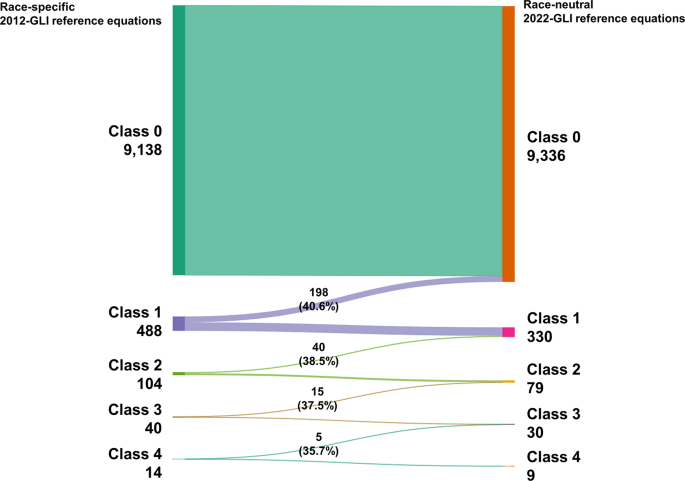
We categorized individuals’ status of disability classification according to the spirometric criteria for the 6 th edition of the American Medical Association Guides to the Evaluation of Permanent Impairment20. There are five classes of disability: Class 0 for both FEV₁ and FVC ≥ 80% predicted, Class 1 for FVC 70–79% predicted or FEV₁ 65–79% predicted, Class 2 for FVC 60–69% predicted or FEV₁ 55–64% predicted, Class 3 for FVC 50–59% predicted or FEV₁ 45–54% predicted, and Class 4 for FVC < 50% predicted or FEV₁ < 45% predicted.
Statistical analysis
Statistical analyses were performed using R software (version 4.3.2; R Development Core Team, Vienna, Austria). Categorical data are presented as counts (percentages), while continuous data are shown as mean ± standard deviation. P-value < 0.05 was considered statistically significant.
Lung function physiologic, FEV1 impairment, and medical disability classification
The distributions of different lung function physiologic, FEV1 impairment, and medical disability groups were determined separately based on percent-predicted values derived using both GLI reference equations and compared. Agreements of the classification of the lung physiologic, FEV1 impairment, and medical disability groups between the two GLI reference equations were analyzed with the Cohen’s kappa test with squared weights21. Cohen’s kappa values are classified as follows: ≤ 0 as no agreement, 0.01 to 0.20 as slight agreement, 0.21 to 0.40 as fair agreement, 0.41 to 0.60 as moderate agreement, 0.61 to 0.80 as strong agreement, and 0.81 to 1.00 as almost perfect agreement.
Association of baseline FEV1 and FVC percent-predicted and respiratory symptoms
Multivariate linear regression models were used to evaluate relationships between baseline FEV1 and FVC percent-predicted values using different GLI reference equations and mMRC dyspnea scale. Additionally, associations of baseline FEV1 and FVC percent-predicted values using different GLI reference equations and the presence of chronic bronchitis were analyzed using multivariate logistic regression models. Adjusted variables for both analyses included age, sex, BMI, and smoking status.
Longitudinal lung function trajectories
Changes of FEV1 and FVC percent-predicted values using the race-specific 2012-GLI and the race-neutral 2022-GLI reference equations over 12 years were analyzed using linear mixed models, with adjustment for age, sex, BMI, and smoking status. A subgroup analysis was performed based on individuals’ sex.
link