
Editor’s note: This is the second story in a two-part series on the use of foundation models in the medtech industry. You can read the first story here.
Medtech firms in radiology are introducing some of the first artificial intelligence devices based on foundation models, even as a regulatory pathway for the technology remains unclear.
Foundation models are a type of AI that are trained on large datasets and can provide multiple outputs, such as detecting several health conditions in a scan. Large medtech firms like GE Healthcare, technology firms like Nvidia and Amazon Web Services, startups, and radiology practices are introducing their own models.
The radiology sector has been an early adopter of the buzzy technology, with the promise of greater accuracy and faster model development, but experts said its benefits still have yet to be proven.
Khan Siddiqui, CEO and co-founder of the AI startup HOPPR, previously worked on healthcare AI and medical imaging at Microsoft. Siddiqui, a trained radiologist who founded HOPPR in 2019, noticed rising radiology workloads amid an ongoing shortage of clinicians.

Khan Siddiqui is CEO of HOPPR.
Permission granted by HOPPR
“My spouse is also a radiologist — we started seeing people burning out,” Siddiqui said.
AI models have been used in radiology since the late 1990s, when the first tools were authorized by the Food and Drug Administration. As of May 2025, the agency has greenlit more than 950 AI-enabled devices in radiology alone, making up a majority of all authorized AI devices.
Many of these models have been one-off solutions, such as models to help flag hemorrhage in scans. However, this doesn’t always align with how patients go through a radiology practice.
“A patient comes in, and has a headache. A headache could be hemorrhage, could be cancer, could be nothing, could be trauma,” Siddiqui said, adding that covering all of the possible conditions would require buying many applications.
Siddiqui wanted to build a large, pre-trained model that could be used across multiple health conditions, patient demographics and scanner types. To accomplish that, he needed a lot of data, which meant building out protections around privacy, security and consent.
Building a foundation model is a “very long, very complex and very costly process,” Siddiqui said. “We’re talking about tens of millions of images.”
HOPPR trained a foundation model on a large dataset of chest X-rays, spanning hundreds of health conditions, Siddiqui said. But the company isn’t taking that model directly to the FDA. Instead, it’s offering it to other medtech companies that want to use HOPPR’s foundation model as the basis for their own fine-tuned models.
HOPPR’s data practices are an important part of that, because if a company wants to sell an AI model for commercial use, they must know where the data came from and have rights to use the data. A lot of research data restricts commercial use, and it’s difficult to know the source of images scraped from the internet.
“Because we source data directly from health systems and large radiology practices, we know exactly where the data came from and can provide that to the FDA as needed,” Siddiqui said.
DeepHealth, a subsidiary of outpatient imaging provider RadNet, is one of HOPPR’s first commercial partners to adopt the technology, Siddiqui said.
Taking a foundation model through the FDA
Aidoc, like HOPPR, sees foundation models as a launching point for more specific radiology tools. The company started working on its own foundation model about two and a half years ago, after the launch of ChatGPT, CEO Elad Walach said.
“It was a massive effort all through the years, but we had a really big breakthrough about six months ago of the first working model,” Walach said. “It took us a lot of trial and error, a lot of resources spent on it.”
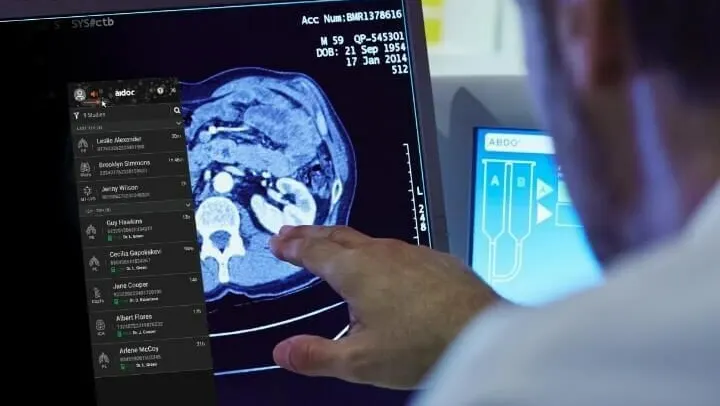
At last year’s Radiological Society of North America conference, Aidoc debuted its CARE foundation model, a vision-language model built using CT and X-ray images, and supporting clinical information such as notes, labs and vitals.
“The way the FDA works today, it’s still disease by disease.”

Walach said Aidoc has since received FDA clearance for two derivative models based on the technology: a rib fracture triage tool and another to detect aortic dissection, a serious condition caused by a tear in the aorta.
“The way the FDA works today, it’s still disease by disease,” Walach said. “The accuracy … has to be super high to actually help physicians.”
Walach said the company’s CARE model is more accurate and comprehensive than the company’s past AI tools. For example, using the technology for abdominal CT scans, which contain dozens of diseases, “for each of them, it was better than every one of our prior models,” Walach said.
Like HOPPR’s Siddiqui, Walach also said the foundation model has reduced development time for derivative models. His goal is to cover more than 100 diseases with AI models in the next three years, “which was truly unimaginable a year ago.”
Aidoc also plans to open its foundation model to other developers in the future.
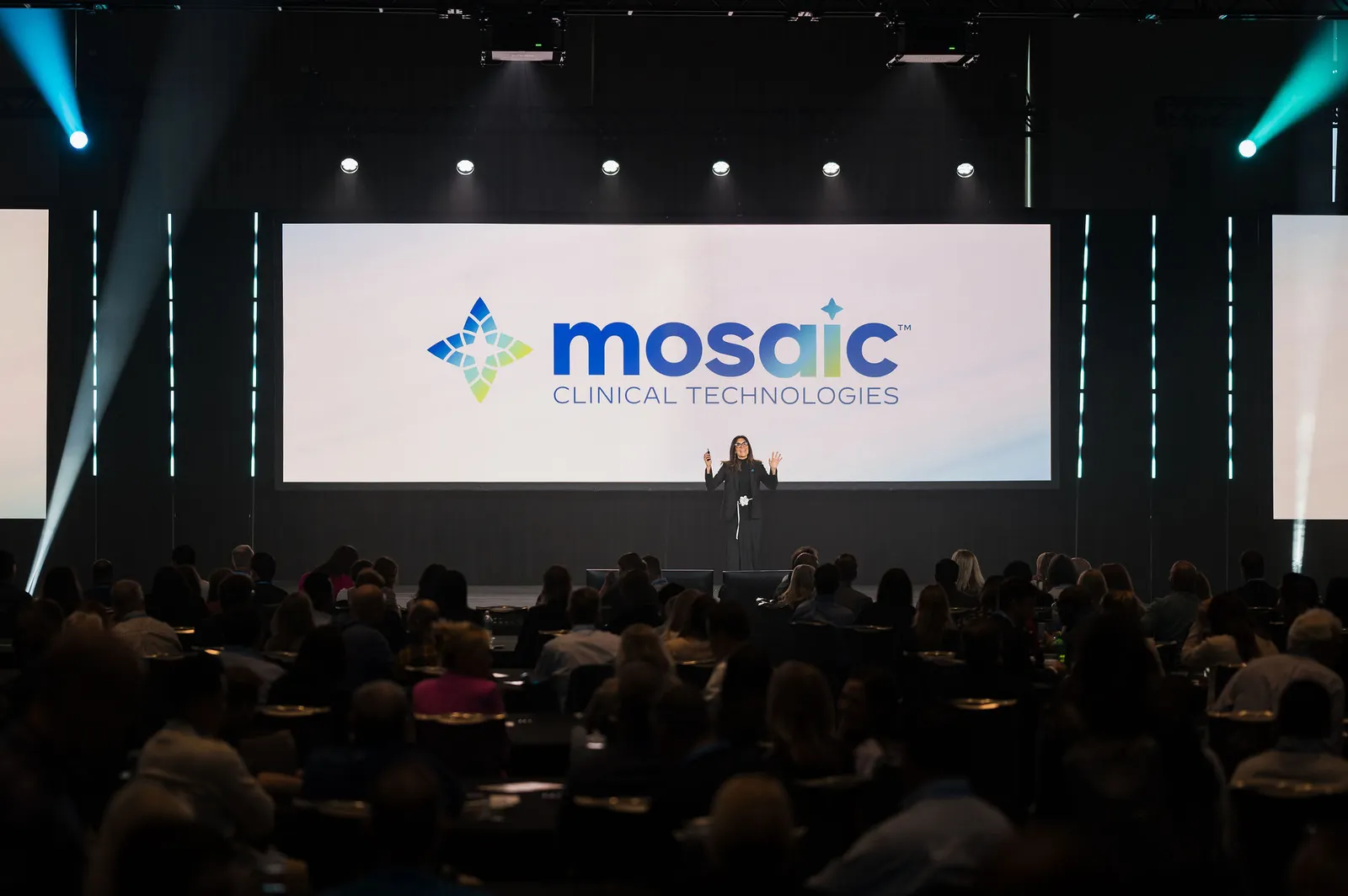
Nina Kottler, associate chief medical officer for clinical AI at Radiology Partners, presents Mosaic Clinical Technologies at the company’s practice leadership summit.
Permission granted by Radiology Partners
Radiology firm pilots foundation model
Radiology Partners, a national practice encompassing more than 3,400 sites, is taking a different approach. The company has made two different models that it is piloting with radiologists.
The first tool, called Mosaic Reporting, uses large language models and voice recognition to structure radiology reports and reduce time spent dictating notes. Radiology Partners has rolled out the model to about 316 radiologists so far, said Nina Kottler, associate chief medical officer for clinical artificial intelligence. Because the tool only uses language, it doesn’t fall under the FDA’s purview.
“A lot of people think of the technology, because it’s so capable, that … someone could just buy it and plunk it in and maybe do a little training. It’s actually far from the truth.”
Nina Kottler
Associate chief medical officer for clinical AI at Radiology Partners
The second model, Mosaic Drafting, is more complex. It combined a large language model and a large vision model to interpret images and pre-draft X-ray reports. A radiologist then reviews, edits and signs off on the findings.
Because the model interprets images, it must go through FDA review. Radiology Partners is testing the tool under an institutional review board, Kottler said, and so far 57 radiologists have access to it.
Feedback so far has been “unanimously positive,” Kottler said, while adding that the company is moving slowly with the rollout.
“A lot of people think of the technology, because it’s so capable, that … someone could just buy it and plunk it in and maybe do a little training. It’s actually far from the truth,” Kottler said. “There is a lot of work that is required for training and change management, and understanding how it fits in the workflow, and making sure you get feedback and continuous monitoring.”
Practices are still figuring out how to handle many of these aspects.
Kottler sees foundation models as the future of AI, adding that Radiology Partners hasn’t looked at a narrow AI solution for about a year.
“People, if they’re worried about it, or they just hear about hallucinations and they’re afraid, I would tell them … get involved,” Kottler said. “This is going to be a part of your future. And you, especially if you’re a clinician or you’re involved in clinical care, need to be the person that is driving it.”
link