
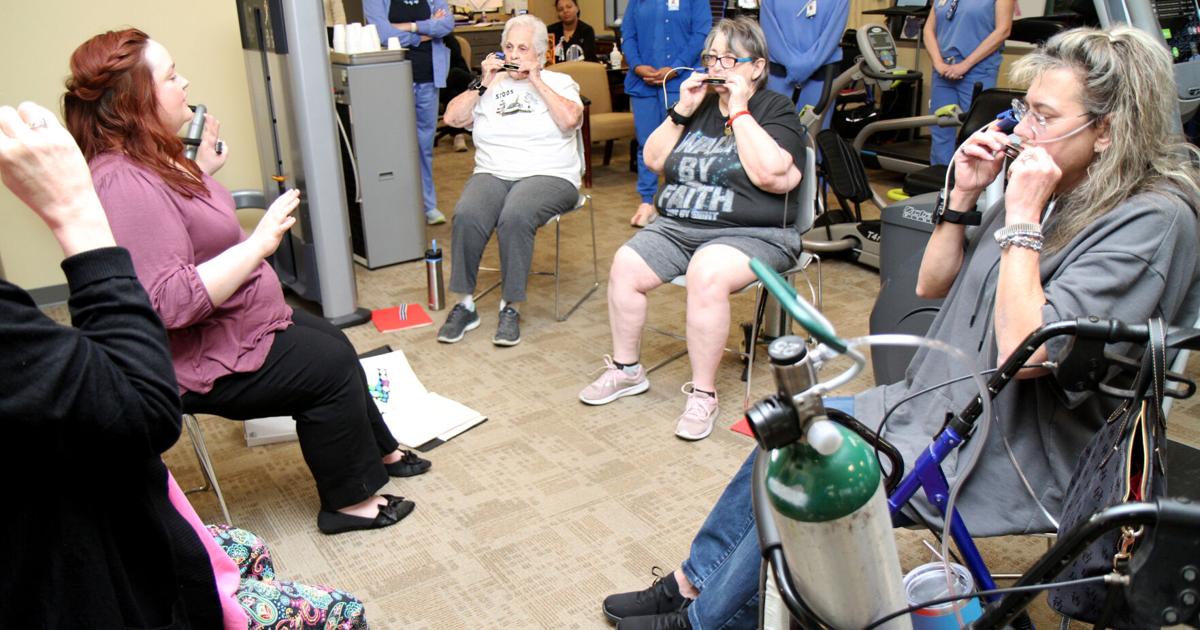
A musician needs full lungs to play the harmonica — that makes the pocket-size instrument just what the doctor ordered for respiratory therapy patients at Baton Rouge General Pulmonary Rehabilitation Center.
Jaqueline McCarthy, a musical therapist at Baton Rouge General, teaches the weekly classes, split up into 15 minute one-on-one sessions.
McCarthy, a former opera singer, also leads a special class once a month for patients wanting to learn the harmonica as respiratory therapy treatment, which helps patients with types of chronic obstructive pulmonary disease, such as emphysema and chronic bronchitis.

Jackie McCarthy, center, music therapist teaches COPD patients how to play the harmonica at the Cardiac Pulmonary Rehab Center on Tuesday, March 11, 2025.
In the class, patients learned the Louisiana classic, “You are My Sunshine.”
Playing the harmonica strengthens the diaphragm and teaches pursed-lip breathing, which helps better oxygenate the blood, according to Jessica Richardson, a registered nurse and team leader at the center.
The technique enables people to inhale and exhale more air, by breathing in through their nose and then breathing out through puckered lips.
“Patients with long-term lung conditions can use this harmonica therapy to strengthen the body,” Richardson said. “The breathing techniques increase the levels of oxygen and makes the diaphragm stronger.”
The deep, deliberate breaths used in playing the harmonica help patients with damaged lungs inflate microscopic air sacs called alveoli, which are where the blood exchanges CO2 for oxygen. In contrast, breathing quick, shallow breaths will cause the alveoli to collapse, making it harder to get air sacs to inflate again — sort of like when blowing up a balloon.

Jacqueline McCarthy (left) teaches Patricia Beebe (right) in a group harmonica class at Baton Rouge General’s Cardiac and Pulmonary Rehab Center.
The best thing about learning to play the harmonica, according to music instructor McCarthy, is that patients don’t need previous musical experience to get the benefits. The harmonica will make it sound good no matter what.
The sheet music is comprised of pluses and minuses (indicating inhales or exhales, respectively) and numbers one through six (indicating where on the harmonica to play).
“The music also gives patients a chance to practice their breathing, and are really able to hear how well their breath control is,” McCarthy said.
Practicing the songs, like “You are my Sunshine,” gives patients an auditory cue for their lung health. It can also provide patients with something positive (like their favorite song) and very focused, actionable task to improve their health.
“Patients can practice songs over and over again until it sounds right,” Mary Malloy said, music supervisor for Baton Rouge General’s Arts in Medicine program. “It’s also just fun.”
Proven differences in lung health
Patients at Baton Rouge General’s harmonica class started with breathing exercises in their chairs to make sure their posture was best for quality breathing (shoulders back, chin parallel to the floor, etc.).

Patricia Beebe learns how to play the harmonica at the Cardiac Pulmonary Rehab Center on Tuesday, March 11, 2025.
The class placed their hands on their stomachs practiced control of the diaphragm — making sure the stomach pushes the hand out to expand and retract when taking deep breaths.
Then it was time to “break out the harmonicas,” McCarthy said.
The musicians warmed up with long inhales followed by short exhales, and long exhales followed by short inhales. The breathing pattern is meant to show patients the difference in volume based on breathing power.
“It take much more work to play softly than really loud,” said harmonica instructor McCarthy, “We try to get the breathing and the sounds as controlled as possible.”
Breathing long inhales helps with oxygenation, and a slow, soft exhale helps get rid of CO2 in the lungs.
The harmonica is another way to tell how well patients are breathing, according to registered nurse Richardson.
“We can hear the notes and how long patients are actually inhaling and exhaling,” Richardson said.
In a 2020 study from the National Library of Medicine, patients attended 12 weeks of harmonica training sessions for 2 hours a week and were encouraged to practice at home.
The pilot study showed that the harmonica program significantly improved measurements used to assess respiratory muscle strength (like PImax, PEmax and 6-minute walk distance) in patients after rehabilitation.
In order to measure the effectiveness of harmonica therapy, Richardson and her team at Baton Rouge General measure a patients’ oxygen levels before and after their one-on-one harmonica sessions. Most of the time, the oxygen levels improve.
According to Richardson, the effectiveness of the musical treatment can depend on the patient, and at what point in their exercises the therapy was (before or after various activities on the treadmill, bike, stretches and more).
“The order that is most helpful for better breathing is very patient-specific,” Richardson said. “But patients tend to love it either way.”

Group harmonica classes at Baton Rouge General bring patients together with a sense of community.
Using music to heal
Beginning in 2012, the Baton Rouge General Arts in Medicine therapy program has provided patients at the Baton Rouge hospital for many different ways to de-stress and find healing through the arts, including painting, knitting, crocheting, live music events, drawing and much more.
“Sometimes the act of focusing on a project or using music to de-stress can really make a difference for our patients,” Malloy said.
In 2019, the program began to expose babies in the NICU to calming, rhythmic sounds that are designed to help babies grown and heal.
Studies show music therapy in the NICU provides a host of benefits, including a stabilized heart rate and improved breathing, feeding, weight gain and sleep. In the NICU, mimicking the sounds of the womb and reducing loud, disruptive noises can be beneficial for premature infants, as they experience a different soundscape than in the womb.
Specifically, Baton Rouge General’s music therapists use low-frequency sounds, like those from the remo ocean disc (a hollow, circular drum that mimics wound sounds) and a gato box (a wooden box with soft pedals that simulates a mother’s heartbeat), can be used to simulate the intrauterine environment.
link