
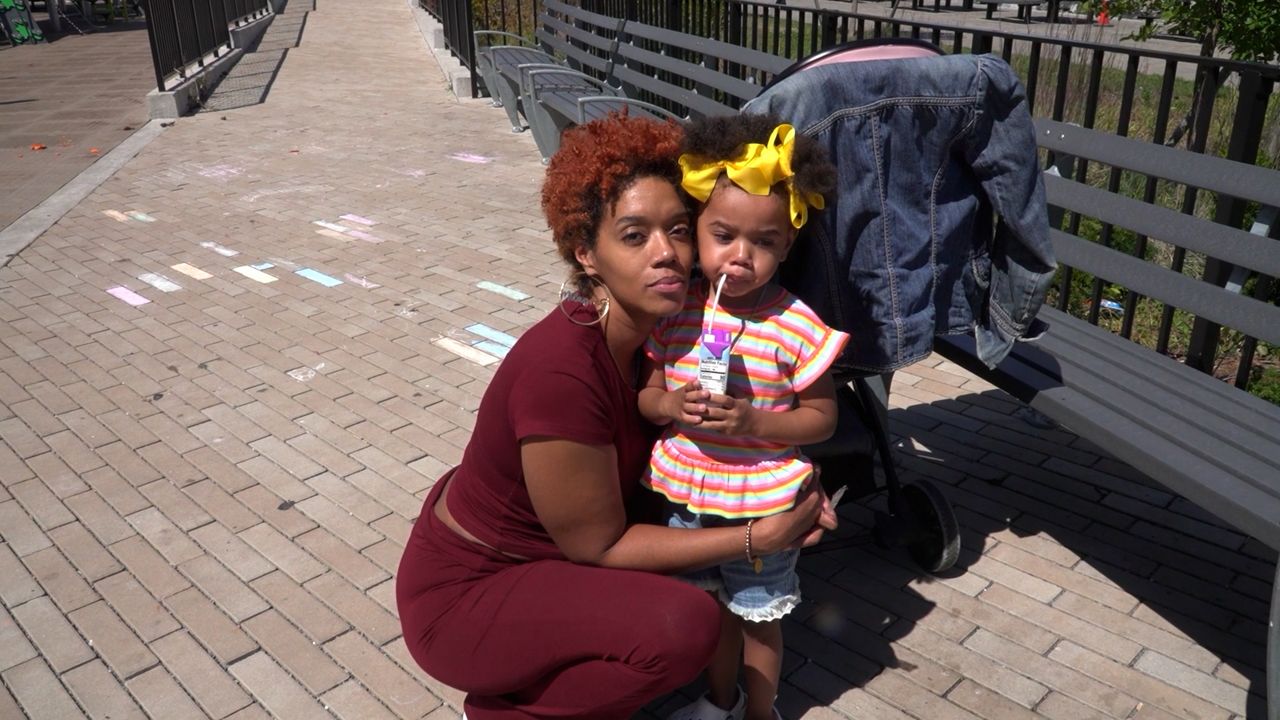
“During my pregnancy, I was just like in a high. I was like blissfully high, amazingly happy,” said Bronx mother Milagros Zapata.
Zapata was so excited during her pregnancy that it never crossed her mind that she may struggle once the baby arrived.
“I was like, ‘okay, I have so much support,’” she said. “’I’m going to be okay. I’m gonna be fine.’ That was the last thing on my mind.”
But shortly after her daughter Tyler was born, Zapata began feeling like something wasn’t right.
“I don’t think I’m supposed to be crying this much. I don’t think I’m supposed to be feeling these feelings at this intensity,” she said.
Focused on caring for her baby, she often didn’t feel like eating or taking care of herself.
“Sometimes I would go like two, three days without wanting to take a shower,” Zapata said. “I would always make sure that she was fine. That was my number one thing, but then as far as myself, I let myself completely go.”
Zapata was eventually diagnosed with postpartum depression, anxiety, and panic attack disorder.
She’s not alone. Nearly 40% of Black mothers experience a maternal mental health disorder.
But not all new moms get help — and women of color are much less likely to do so. While Black mothers are more than twice as likely as their white counterparts to struggle with their mental health during pregnancy or the postpartum period, they’re half as likely to receive treatment.
“We see higher rates of maternal mental health problems in Black mothers for a variety of reasons,” said Dr. Kanika Harris, the Executive Director of the National Association to Advance Black Birth. One factor contributing the rate of mental health issues, Harris explained, is that Black women are more likely to experience trauma during pregnancy and birth.
“Trauma can look like you have a birth that, and you have complications you didn’t expect, you felt like you were not heard,” Harris said, “where you felt like your basic needs and rights were not taken seriously.”
Even after traumatic experiences, many Black mothers feel they’ll be judged if they speak up about their mental health.
“We’re not really allowed to really experience issues of being tired, of being overburdened, of being stressed, because history shows that when we say, ‘hey, it’s been too much, hey I can’t handle it,’ we’ve been stereotyped as lazy,” Harris said.
This pressure to push through can be deeply rooted for many women of color, according to Dr. Harris.
“I think one of the biggest fears is how we’re stereotyped, and will you call Child Protective Services on us,” said Harris.
Zapata is seeking to challenge this fear head on by speaking out about her own struggles — and advocating for others to do the same.
Zapata said, “Seeing me speaking out or seeing another woman who looks like them speaking out, it might give them the courage to say, ‘okay, you know, she got help. And she’s fine. Nobody took her children away, you know.’”
But it may take larger societal shifts to make lasting change.
“As a woman of color, if you get through the struggle, you are strong. You’re independent,” she said. “It’s okay to be strong, but being strong is also having the courage to admit that you’re not okay, that you need that additional help .”
Zapata found help through a mom’s support group at the hospital where she gave birth —as well as through therapy and medication.
“I did get help from me, but obviously I did help for my daughter as well, because I want to be here for her,” Zapata said. “And I want show her that it’s okay to ask for that extra help when you do need it.”
Zapata hopes she can break the cycle with the example she is setting for her daughter.
If you or someone you care about might be suffering from postpartum depression or another perinatal mental health disorder, free support is a phone call away and no diagnosis is needed to get help. These conditions are temporary and treatable; nobody should suffer. Call the Postpartum Support International helpline at 1-800-944-4773 (English and Spanish), visit postpartum.net, or download the Connect by PSI mobile app.
link